
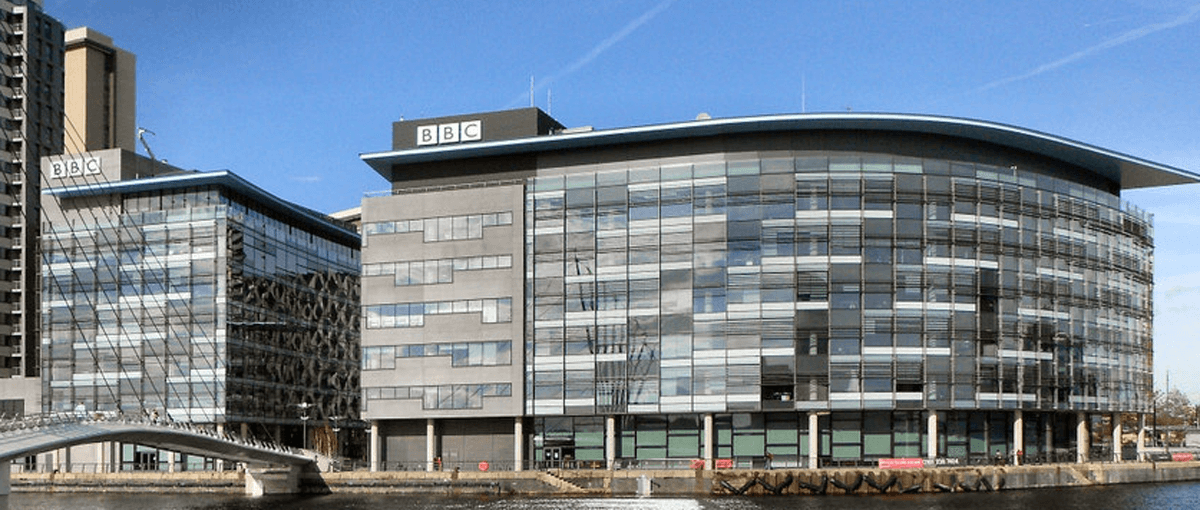
STRETCHING LOCALITY: An evening music programme produced at the BBC’s Media City studios in Salford, pictured, is regarded by regulator Ofcom as ‘local’ for BBC Tees in Middlesbrough. Picture: © David Dixon, 2011, CC by 2.0 SA.
Just a year ago, in October 2025, the BBC’s local radio managers promised regulator Ofcom – as they applied for yet another change in the operating licence – that some output culled two years previously might return…but only if Ofcom approved the amendment.
The managers first approached Ofcom about altering the licence the previous February, but the application wasn’t made formal until the October – after an all-England Sunday afternoon programme had been launched across the 39-stations of the Corporation’s local radio network.
Broadcasting nerds – whose attention to the details, minutiae and imprecise wording of the original Ofcom operating licence (which seems to have had more regenerations than Doctor Who) – rarely fail to spot the latest moves in what seems to have become an increasingly long-drawn-out chess game between BBC managers and the regulator noticed the anniversary; of course they (we) did.
Applying for last year’s licence change, BBC managers wrote: “If these changes were made, we would plan to increase the number of Saturday breakfast programmes from 17 to 19 shows and the number of Saturday daytime shows from 19 to 21.”
Wording in the consultation submission reads like a firmer commitment: “If this change is made, we will be able to offer a greater volume of more local programming in higher listening hours, thereby increasing the public value of local radio.”
Managers also said: “Our proposal will benefit audiences by securing local programming through the provision of more local content, particularly in those periods when listening is high.” (My italics.)
Not only have those programmes never materialised but, last month, BBC managers announced they were to cut the number of shows between 6am and 2pm on Saturdays by half, as well as replacing local and regional output with four hours of All-England programming, from 6-8am and 12-2pm.. (Radio Today reported that a late show across England would be shared with Radio Five Live.)
The changes are expected in January.
Who was asked and who was heard?
Last year, Ofcom did carry out a consultation – that, when subjected to scrutiny against the regulator’s own transparency and accountability standards by sceptics like me – seemed more gesture than substance.
It was barely publicised and lasted just four weeks.
That Ofcom had said it was “minded” to allow the changes in their introduction, looked far too much like a foregone conclusion.
The exercise was necessary because, without another regeneration of the licence, most stations would have breached minimum local hours quotas after the introduction of the all-England Sunday afternoon show.
Requirements that were seen as lax were relaxed so far that, now, an evening music programme produced in the BBC’s Media City studios counts as “locally made” for BBC Tees listeners in Middlesbrough.
Sceptics – again including me – got the impression that Ofcom was willing, as ever, to oblige BBC managers, letting them do as they please with local radio.
And the implications
Approval meant the executives got not only what they wanted, but far more.
This time round, while appearing to renege on their apparent commitment, BBC managers didn’t need to apply for a further regeneration; they could just do it.
Since 2023, local radio output has been cut by more than 40 per cent – a move which has driven more than 2 million listeners to other stations (some of which hired their favourite presenters when they lost their jobs).
In three years, “overall engagement” across all platforms – regional TV, local radio and online – with the BBC’s England audiences falling from 50 per cent in 2023 to 43 per cent this year.
How it looks
For sceptics with (far from elephantine) year-long memories, it’s all too easy to regard BBC executives as taking advantage of last year’s regeneration to not only dodge Ofcom but – probably unintentionally (to give them some credit) – further undermine its credibility as BBC regulator.
It’s also too easy to regard last year’s manoeuvres as misleading Ofcom who, in turn, undermined the consultation and licence fee payers because it lacked transparency and accountability.
Also, it seems hard to believe that the deluge of cuts that the BBC has announced and has been making across the board since the spring weren’t at least on the horizon six months earlier.
And now?
With the Department for Culture, Media and Sport hard at work to draft BBC Charter renewal legislation to go before parliament next year, this seems an appropriate opportunity to include regulation that is more transparent and accountable.
And that’s before anyone starts to look at the need for greater scrutiny of local government (in all its forms), following Prime Minister Andy Burnham’s determination to see greater devolution in England. At a time, when commercial local news outlets are still contracting, the need for far more, genuinely local radio, and a stronger Local Democracy Reporting Service couldn’t be greater.
If you agree, then log on to https://www.writetothem.com/ and tell your MP (and please include a link to this).
The views expressed here are those of the writer.© The author. All rights reserved.